
1
Layer 01
Material (CAPEX)
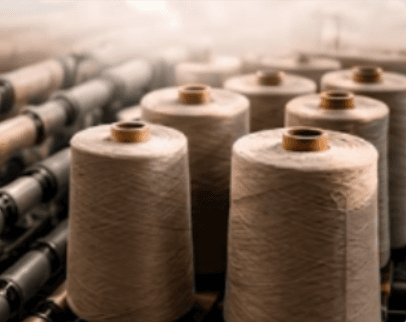
Revenue from advanced yarn and fiber sales, fabric and component sales, and custom formulations. This serves as the tangible entry point for procurement and innovation.
The Model
Transforming Textiles into Sovereign Value
The RE:WEAVE™ business model moves beyond traditional transactional sales to a recurring value framework. By monetizing the entire material lifecycle—from initial engineering to digital compliance and autonomous recovery—the system generates compounding, long-term value for partners.
01 — Revenue architecture
RE:WEAVE™ monetizes physical materials, digital infrastructure, lifecycle recovery, and data intelligence.
Layer 01
Revenue from advanced yarn and fiber sales, fabric and component sales, and custom formulations. This serves as the tangible entry point for procurement and innovation.

Layer 02
Digital infrastructure for compliance, Digital Product Passports (DPP), and ESG reporting. This acts as the compliance engine for the Material Operating System.
Layer 03
Revenue from take-back programs, recycling services, and material regeneration. This layer removes future regulatory and reputational costs by acting as an EPR cost shield.
Layer 04
High-margin data products, predictive analytics, and lifecycle optimization insights. Revenue in this layer scales with system usage rather than material volume.
THE FUTURE
Re:Weave™ enables a new era of sovereign infrastructure — where materials, data and intelligence work together to create lasting economic, environmental and strategic value.

STRATEGIC SOVEREIGNTY
Control critical materials, data and infrastructure.

CIRCULAR PROSPERITY
Regenerate resources and create long-term value.

COMPETITIVE EDGE
Lower costs, reduce risk and unlock new markets.

A RESILIENT FUTURE
Design infrastructure that endures and adapts.

THE NEXT ADVANTAGE IS SOVEREIGN.
Re:Weave™ transforms today's challenges into tomorrow's infrastructure. Let's build what lasts.

SECURE

CIRCULAR

SOVEREIGN

SCALABLE
REGULATIONS ARE TIGHTENING
100+
EPR policies active or in development worldwide by 2030
COSTS ARE RISING
+30-70%
EPR policies active or in development worldwide by 2030
RESOURCES ARE CONSTRAINED

<1%
of textile materials are recycled back into new textiles³
STAKEHOLDERS EXPECT MORE

76%
of brands cite sustainability as a key driver of future growth⁴
REGULATIONS ARE TIGHTENING

COSTS ARE RISING
RESOURCES ARE CONSTRAINED
STAKEHOLDERS EXPECT MORE
Sense - Tex™
Pillar 5
Material Innovation.
System Intelligence.
Lifecycle Protection.
High-spec. Critical. Mission-Driven.

Total Price
~109 €/kg
1. BASE MATERIAL (CAPEX)
~55 €
High-performance yarn (silver, zinc). Entry point for procurement.
2. SYSTEM LICENSE (OPEX)
~32 €
DPP, traceability, ESG reporting. Compliance engine.
3. LIFECYCLE RECOVERY
~22 €
Take-back, recycling, EPR protection. Regulatory cost shield.
BEST PERFORMANCE | HIGHEST PROTECTION
Balanced Performance. Proven Value.

Total Price
~85 €/kg
1. BASE MATERIAL (CAPEX)
~40 €
Competitive procurement price. Entry point for procurement.
2. SYSTEM LICENSE (OPEX)
~25 €
Digital Product Passport, ESG, traceability. Compliance + data layer.
3. LIFECYCLE RECOVERY
~20 €
Circular handling, cost protection. Future cost shield.
OPTIMAL BALANCE | REFERENCE MODEL
Scalable. Efficient. Accessible.

Total Price
~73 €/kg
1. BASE MATERIAL (CAPEX)
~34 €
Cost-efficient material for scaling. Low barrier to entry.
2. SYSTEM LICENSE (OPEX)
~24 €
Essential compliance + traceability. Core system access.
3. LIFECYCLE RECOVERY
~18 €
Basic EPR coverage and recovery. Regulatory protection.
COST-EFFICIENT | RAPID SCALABILITY
Ultra Simple Material Model
MATERIAL
Entry Point (CAPEX)
LICENSE
Compliance + Data (OPEX)
LIFECYCLE
Risk Removal (EPR Shield)
REGULATORY READY
DPP · ESPR · EPR

CIRCULAR BY DESIGN
Recover · Recycle · Reuse
DATA-DRIVEN COMPLIANCE
DPP · ESG · Traceability

FUTURE-PROOF INFRASTRUCTURE
Sovereign · Secure · Scalable

The Model in One Line
The material is the entry point, the license delivers compliance and traceability, and the lifecycle layer removes future regulatory cost.
Why This Model Works
03 — Strategic return
Sovereign infrastructure creates recurring value across the entire material lifecycle.
Sovereignty

Partners gain control over critical materials, data, and infrastructure.
Compliance
Built for total compliance with EU regulations like ESPR, DPP, and EPR.
Risk exposure
Our model mitigates non-compliance risk, with fines reaching up to 10% of annual turnover.
Resilience
The integrated system lowers long-term operational costs and reduces strategic vulnerability.
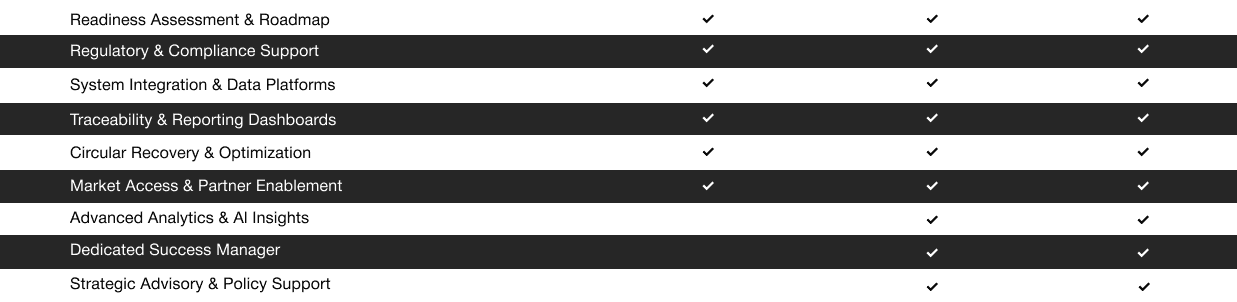
04 — Engagement framework

Foundation
€25K
per engagement / project
Establish compliance, assess risk and design your roadmap.
Integrate
€75K
per engagement / project
Integrate systems, enable traceability and optimize operations.
Expand
€150K
per engagement / project
Scale capabilities, unlock new markets and drive circular performance.

Sovereign Partner
Custom
Full-service partnership for sovereign infrastructure and long-term leadership.
ROI Focus
Lower risk. Lower costs. Higher returns.
Scalable Engagements
Lower risk. Lower costs. Higher returns.
Long-Term Value
Sustainable infrastructure. Resilient advantage.
Flexible Models
Project-based or retainer. Tailored to your needs.
05 — Implementation guide

Existing Materials, Products or waste Streams

Select a point of entry or combine for a full system

Connect Materials, Recovery and Processing

Recovery → Transformation → Reintegration
Existing Materials, Products or waste Streams
Select a point of entry or combine for a full system
Connect Materials, Recovery and Processing
Recovery → Transformation → Reintegration

Re:WeaveCircular Infrastructure
Re:Weave is designed to be implemented in different ways depending on the level of integration required.
It can be deployed as a full circular system, where all four pillars operate together to create a closed-loop infrastructure for materials, energy, and biological processes. This approach is relevant for new facilities, advanced environments, and long-term system design where circularity is built in from the beginning. At the same time, each pillar can be used independently.
Hybrid material systems such as Sense-Tex can be licensed and integrated into existing product lines, enabling circular-ready materials without requiring immediate infrastructure change. AI soil transformation units can be deployed to support regenerative systems and biomass production in controlled environments. Modular processing systems, including bioreactors and recovery units, can be integrated into existing factories to improve material recovery and reduce waste. Circular robotics and AI control systems can be introduced to automate sorting, processing, and system optimization.
This modular approach allows companies to transition gradually, starting with specific material streams or system components and expanding over time. Re:Weave therefore functions both as a complete infrastructure system and as a set of interoperable technologies that can be adopted step by step.
06 — Financial outlook
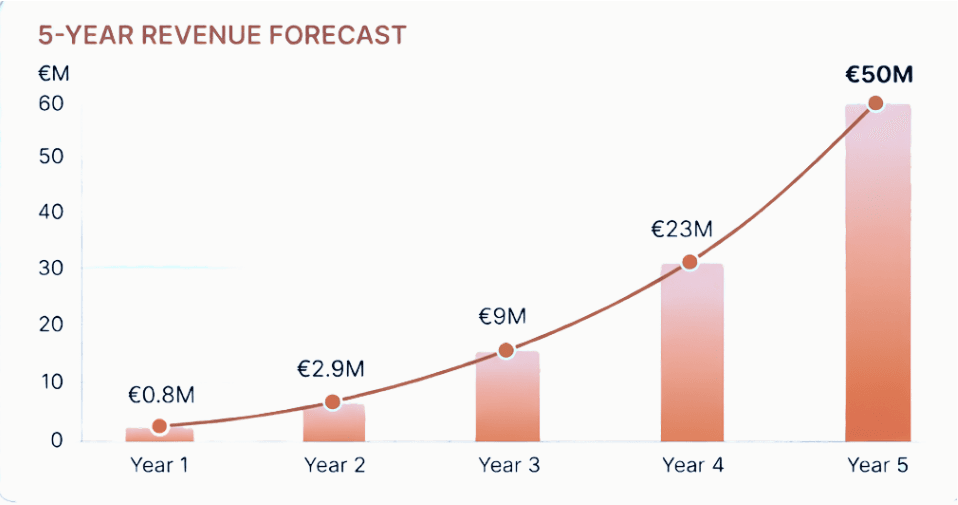
The financial model projects a compounding trajectory as regulation turns circularity into an operational requirement.
Year 1
€0.8M
Pilot contracts, demonstrators, and system validation.
Year 2
€2.9M
Technical validation and protective textiles deployment.
Year 3
€9M
Expansion into Healthcare and Smart City circular infrastructure.
Year 4
€23M
Global network deployment and advanced robotics integration.
Year 5
€50M
Fully autonomous, sovereign infrastructure as a global standard.
07 — The financial model
The financial model
Indicative scenario based on system architecture, supplier inputs and regulatory cost pressure.
Material Sales

System Licensing

Lifecycle Recovery
Data Intelligence
Revenue grows as regulation turns circularity, traceability and recovery into operational requirements.

Space / Defense
License + data heavy
Healthcare
Lifecycle + compliance heavy
Smart Cities
Infrastructure + data heavy
Fashion
Material entry → DPP expansion